INFRASTRUCTURE
The Setura Engine
Setura is built to look past the surface of a grade. We provide the infrastructure to identify exactly where student process fails, turning assessment into a roadmap for improvement.
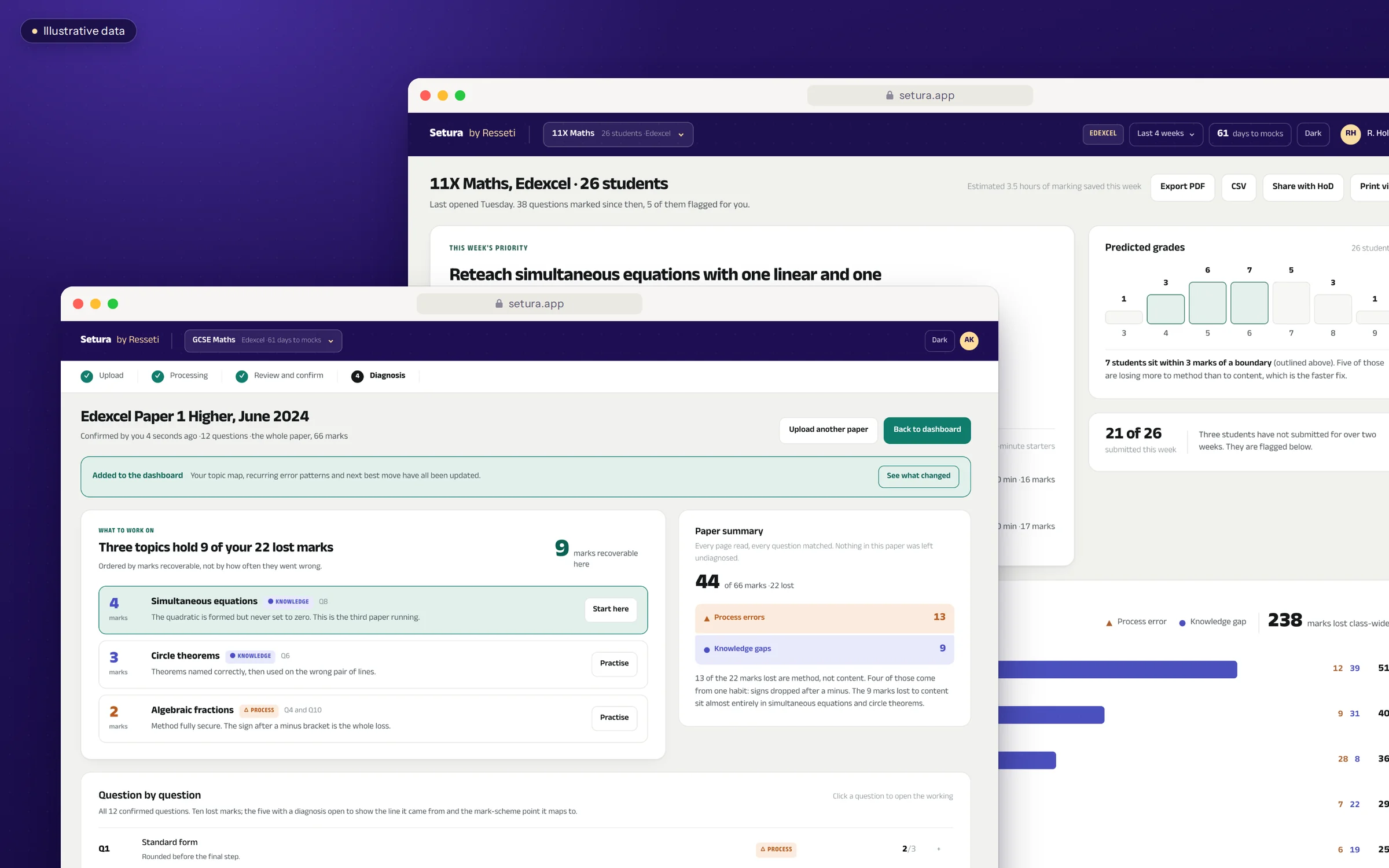
Illustrative example; not based on verified data.
THE ARCHITECTURE
Careful engineering for educational clarity.
Setura maps student responses directly to mark-scheme logic. We identify the exact point of failure in a process, distinguishing between a conceptual gap and a simple procedural slip.
Most marks are lost during execution, not through lack of knowledge. Our engine tracks every step of the student's method, ensuring that the logic remains sound from start to finish.
We turn raw assessment data into clear, pedagogical feedback. Teachers receive immediate clarity on where to intervene, allowing for targeted support that actually moves the needle.
Mapping the Mark-Scheme.
Diagnostic Mapping
Setura ingests student responses, mapping every step against established mark-scheme criteria to identify precise points of failure.
Process Analysis
We isolate the exact moment a method is misapplied, distinguishing between conceptual gaps and simple procedural errors.
Failure Identification
The engine highlights where logic breaks down, providing clear, actionable data on why marks were lost during the assessment.
Targeted Feedback
Educators receive granular insights, allowing for precise interventions that address the specific process errors identified.
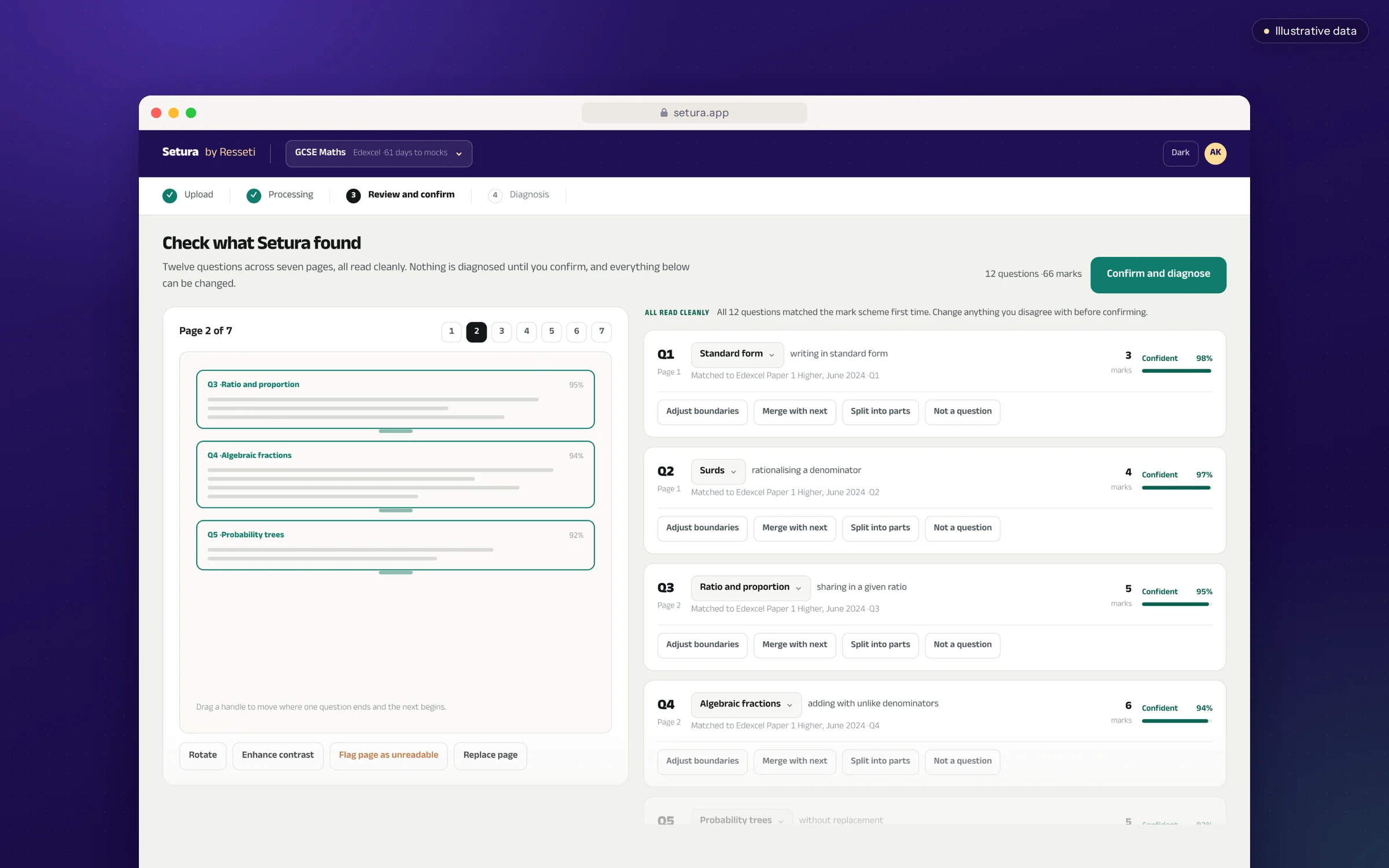
Setura turns raw assessment data into actionable pedagogical insights.
Book a pilot callCONTINUOUS IMPROVEMENT
The system gets sharper with every case it sees.
Cases the deterministic rule layer and model escalation cannot confidently resolve receive a machine-drafted classification first, which the human verifier then confirms or corrects, before being added to the verified set used for retraining. Once enough accumulate, that verified data is used to retrain a smaller, faster classification model. This means more cases resolve instantly and deterministically over time, reducing escalation frequency.
Edge-Case Flagging
Submissions that cannot be confidently resolved by the deterministic rule layer and model escalation tiers receive an automatic draft classification, which is then routed to a human verifier who confirms or corrects it.
Verified Corpus Expansion
Every expert intervention and correction is systematically catalogued into an expanding reference repository of confirmed, verified process outcomes.
Model Retraining
As verified examples accumulate, the dataset is utilized to fine-tune compact, specialized classification models engineered for low-latency scoring.
Compounding Determinism
A higher proportion of subsequent submissions resolve instantly and deterministically, systematically decreasing escalation rates over time.
Explore the continuous feedback loop in deployment
Review diagnostic benchmarks and setup parameters for institutional cohorts.